

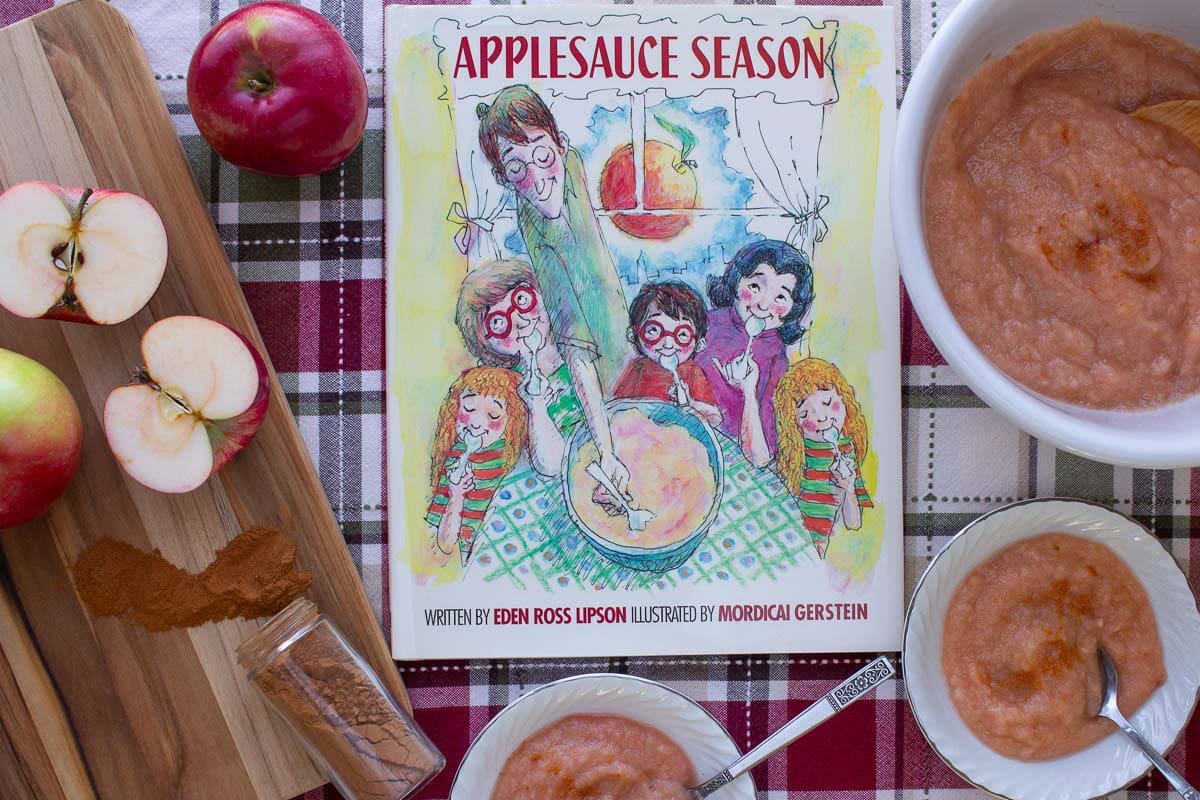
This kid-friendly Homemade Applesauce recipe is naturally sweetened with fresh apple cider, just like in the book Applesauce Season! It’s smooth, delightfully pink, and so fun to make as a family in the fall.
Going apple picking every fall is a highlight of living in New England for me, and it's a great activity to do with kids. Everybody's outside, you get to sneak bites of different varieties straight from the tree (your secret is safe with me), and there are usually cider donuts waiting at the end. Everybody wins!
Until, of course, you get home, and what seemed like a diminutive bag of apples at the orchard proves to be a veritable mountain to pack into the fridge. To use them up, you're in luck: making homemade applesauce is another easy and fun family activity.
About Applesauce Season

I can't remember who gave me a copy of Applesauce Season years ago, but I'm very glad they did. Written by Eden Ross Lipson and published in 2009, the book features the story of a little boy living in a city who waits all year for apples to appear at the farmers market so he and his family can make their famous applesauce together. The author clearly loves apples deeply (same!) and the book is a lovely ode to family traditions and family recipes.
The beautiful illustrations by Caldecott Medal winner Mordicai Gerstein capture the family's recipe step by step, as well as their true excitement and love of all things apple. I love the vibrant drawings that are full of energy, conveying the joy the family feels while making and sharing their applesauce all autumn long.
Recipe Inspiration

I love apple names. In our markets, first come Ida Red and Paula Red, Twenty Ounce and McIntosh, Ginger Gold and Jonagold. We buy six pounds of apples for sauce, because that's just how much our saucepot holds.
Eden Ross Lipson, Applesauce Season
What I love about Applesauce Season is that along with our passion for local, seasonal apple varieties (Macouns forever!), the author and I make applesauce just the same way. Fresh apples are quartered and tossed into a pot with some liquid, cooked down until soft, and passed through a food mill for the perfect nubbly-yet-smooth texture.
The best part of making applesauce this way is that there's no need to peel or even core the apples—the food mill, a handy-dandy, old-fashioned tool, strains out the skins, stems, and seeds for you after cooking. Just crank the apple pulp through the mill and it will grind it into a coarse, saucy purée with the solids left behind in the basket. (It's great for making tomato sauce and creamy mashed potatoes, too!)
Keeping the skins in the pot as the apples cook lends tons of apple-y flavor to the applesauce and tinges it a pretty pink color, depending on the type of apples you use. In the story, the family adds apple cider to the pot to cook along with the apples, and I thought that was a genius idea.
Fresh, sweet apple cider (not be confused with apple cider vinegar!) is unfiltered apple juice that's bursting with deep, concentrated apple flavor. When I swapped it in for the water in my usual applesauce recipe, I was amazed at how much flavor and natural sweetness the cider offered. Made this way, I didn't need to add any extra sugar to the finished applesauce, though you can if your apples are on the tart side.

Rather than the full six pounds of apples called for in the book, my version of the recipe calls for just two pounds. It's enough to fit in a standard saucepan and makes just shy of four cups of applesauce—plenty to enjoy as a snack over the course of a week or two while it's in the fridge.
You can, of course, scale this recipe up if you like! Double or triple the ingredients and cook the apples in a large Dutch oven or stockpot. I've made big batches of applesauce before during visits to classrooms and after school programs, and the kids always have a wonderful time. I even have proof:

A translation, in case you need it: "Dear Chef Afton, Thank you for making applesauce. We love the sauce. We love that you came. It was yummy!" (Shoutout to my dear friend Meg, now the owner of the wonderful Alice, Ever After Books children's bookstore in Buffalo, NY, who welcomed me into her kindergarten classroom many years ago.)
Ingredients You'll Need
To make this Homemade Applesauce, you'll need:

- Tangy apples: I love using tangy-sweet McIntosh, Pink Lady, Jonagold, or Ida Red apples here, but you can use just about any apple you like in this recipe. Try a mix of tart and sweet, just like in the book!
- Fresh apple cider: Sweet apple cider gives extra apple flavor to the sauce; find it in the produce section at your market. If you can't find it, regular 100% apple juice will work here, too. Whatever you do, don't use apple cider vinegar!
- Salt: A pinch of salt makes this applesauce taste even sweeter.
- Warm spices: A pinch of warm spices is optional, but I love the depth it brings to the finished applesauce. Apple pie spice, which I wrote about for King Arthur Baking Company, is a favorite of mine to use here, but you could use pumpkin pie spice or just cinnamon instead.
- Sugar: If your apples and cider are sweet, you may not need any added sugar at all for this recipe. But taste and add what you need until it's just right.
As with every recipe, before you start cooking, make sure to measure out and prepare your ingredients ahead of time. Then, you'll have everything you need when you need it! For all of the ingredient measurements and details, see the recipe card below.
How to Make Homemade Applesauce
The full recipe with detailed timing and instructions for this applesauce is below, but here are some key moments to look out for along the way:

- Quarter the apples: Halve, then quarter the apples—no need to core or peel, if you're using a food mill!

- Add the apple cider: Pour in some fresh apple cider to the pot—it will create steam and flavor the apples as they cook.

- Cook until soft: Cook, covered, until the apples are very soft and mostly broken down into mush.

- Pass through a food mill: Transfer the cooked apple pulp to a food mill and crank to push the sauce into a bowl, leaving the skins and seeds behind.

Why This Recipe Is Great for Kids
I've spent years writing cookbooks and creating recipes that are safe, fun, and engaging for kids and home cooks of all ages. Here are some key features of this recipe that make it perfect for kids and families to make together at home:
- If you're using a food mill, there's no need to peel or core the apples, which can be hard for kids to do. Older kids can practice their knife skills by cutting the apples into quarters without having to worry about anything else.
- Cranking the apples through the food mill is fun! Everyone in the family can take a turn. If you don't have a food mill, you will need to peel and core the apples, but you can still have fun cranking—kids love using this apple peeler/corer.
- This recipe is totally doable for an after school or short weekend activity—it should take just about 45 minutes from start to finish, and then you'll have applesauce to snack on for a few days following.
- Looking for more post-apple-picking recipes to make together? Try some Fried Apples and Onions!
Let's Cook!
Gather your equipment, measure your ingredients, and get cooking with this kid-friendly recipe! If you loved making it together, please leave five stars and share your stories in the comments.

Homemade Applesauce
Good To Know
- If you don’t have fresh apple cider or apple juice on hand, you can use water instead. You’ll likely need to use the optional sugar to make up for the lost flavor and natural sweetness.
- You can use just about any apple you like in this recipe. Sweeter apples like Honeycrisp or Fuji will make a sweeter applesauce, and tart apples like Granny Smith will make a less-sweet sauce. You can also use a combination of different kinds, if you like! The only kind of apple I don’t recommend using is Golden Delicious—they have lots of pectin in them and don’t break down well into a smooth sauce.
- If you don’t have a food mill, peel and core the apples before cutting them in step 1 (this tool makes the task fun!), then mash the applesauce with a potato masher or blend it with an immersion blender after cooking and cooling. The resulting sauce will be more chunky than smooth and less pink, but will still be delicious.
Equipment You'll Need
- Cutting board
- Chef's knife
- Large saucepan with lid
- Wooden spoon
- Oven mitts
- Food mill (see recipe note)
- ladle
- Large bowl
- Quart-sized jar or other airtight container (optional)
Measure Your Ingredients
- 2 pounds tangy apples (such as McIntosh, Pink Lady, Jonagold, or Ida Red)
- 1 cup fresh apple cider or apple juice
- 1 pinch table salt
- 1 pinch apple pie spice or pumpkin pie spice (optional)
- 1 to 2 teaspoons granulated sugar (optional)
Let's Cook!
- 2 pounds tangy applesPlace the apples on a cutting board. Use a chef’s knife to cut each apple in half through the stem end. Lay the halves flat on the cutting board, then cut them in half again.
- 1 cup fresh apple cider or apple juice, 1 pinch table saltTransfer the quartered apples to a large saucepan (stems, seeds, skins, and all!). Add the cider and salt. Cover the saucepan with a lid and cook over medium-low heat, stirring occasionally with a wooden spoon, until the apples are very soft and falling apart, 20 to 25 minutes.
- Turn off the stove and slide the saucepan to a cool burner. Use oven mitts to remove the lid and let the applesauce cool down a bit, about 10 minutes.
- Set a food mill over a large bowl. Use a ladle to transfer the cooked apples and the liquid in the pot to the food mill basket until it’s mostly full. Crank the apples through the food mill into the bowl (the skins and seeds will be left behind in the basket). Repeat until you’ve passed all of the apples through the mill. Discard the skins and seeds.
- 1 pinch apple pie spice or pumpkin pie spice, 1 to 2 teaspoons granulated sugarStir in the spices and sugar to taste, if using. Serve warm or transfer to a quart-sized jar with a lid or other airtight container and refrigerate for up to 1 week. A little extra sprinkle of apple pie spice or cinnamon is a nice touch on top of each serving, too!
Conversation Starters
As you sit down to enjoy your homemade applesauce, talk about what it was like to make the recipe and the themes in Applesauce Season. You can help young readers make connections to the book and share your own answers, ideas, and stories with them with the following prompts:
- Do you have a favorite kind of apple? What is its name, and what do you love most about it?
- In Applesauce Season, it's a tradition for the family to make applesauce together every fall. Is there a recipe that you or someone in your family makes every year? Maybe for a holiday or special celebration?
- Apples are a favorite fruit to enjoy in the fall. What's your favorite season, and why? Is there a special thing you like to eat at that time of year?

Comments
No Comments